
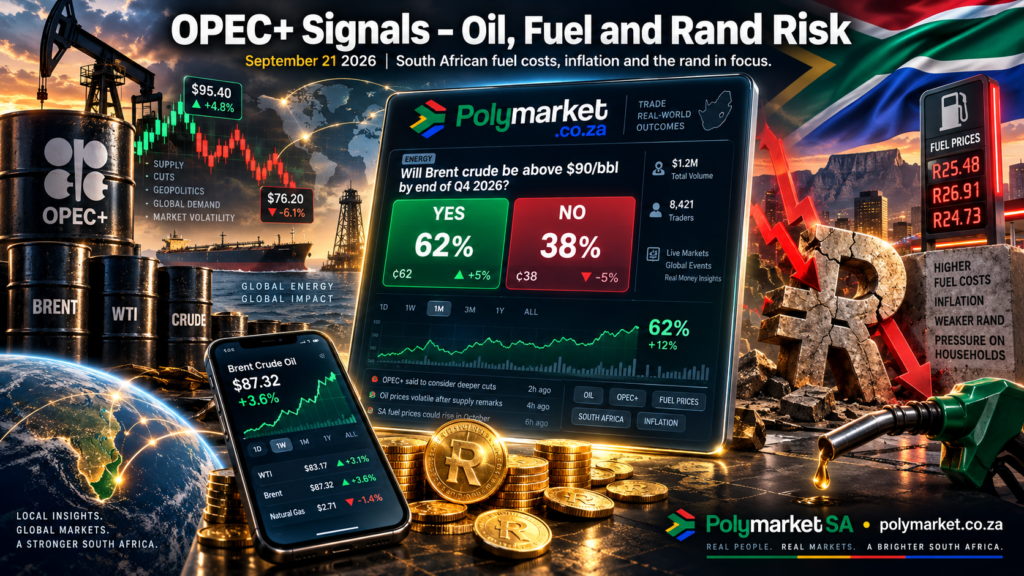
It’s Monday 21 September 2026, and oil markets are back in focus after a fresh round of OPEC+ supply signals. Traders are trying to judge whether the producer group will keep the market tight or allow more barrels onto the market as demand concerns linger.
For South Africa, that debate is not abstract. Oil prices feed directly into the local fuel-price formula, transport costs, and inflation. When crude jumps, the Rand often feels a second hit if the Dollar also stays firm. Traders on Polymarket.co.za are starting the week by mapping OPEC headlines onto fuel costs, imported inflation, and the South African Reserve Bank’s limited room to ease.
1. OPEC+ Has Put a Floor Under Oil Volatility
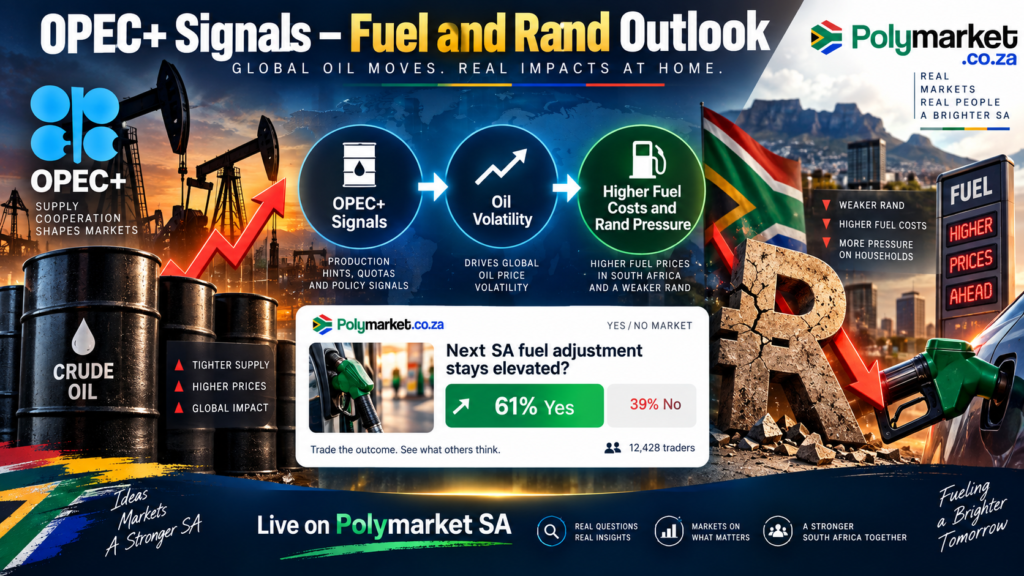
The market is less focused on one official statement and more focused on whether supply discipline holds. Any hint of tighter output supports crude. Any hint of faster supply increases can cap prices. Either way, the result for South Africa is uncertainty at the pump.
On Polymarket SA, traders are pricing the near-term impact:
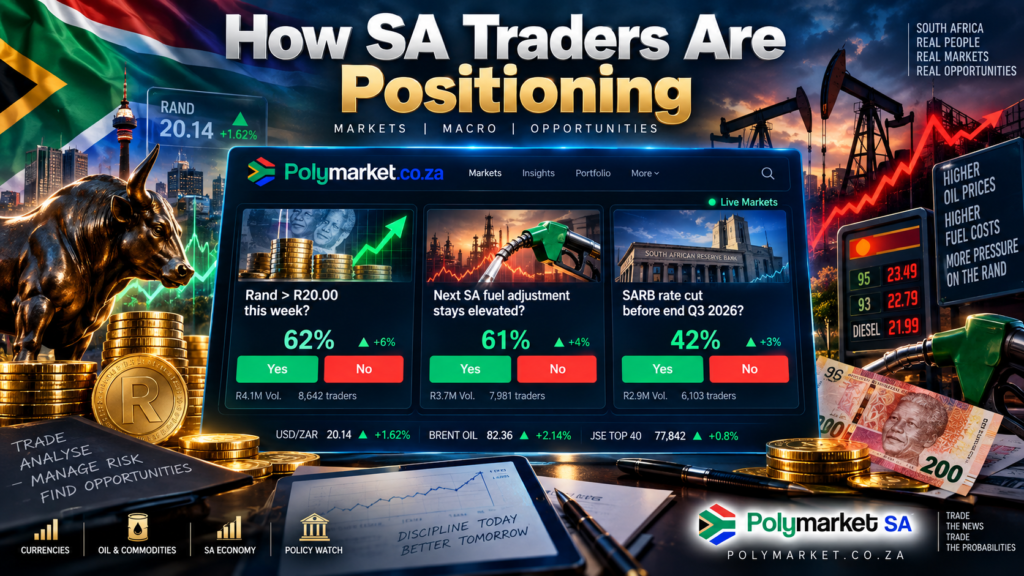
- The probability that the next South African fuel-price adjustment stays elevated is currently trading at approximately 61% Yes.
- Markets linked to oil-driven inflation pressure have seen a pickup at the start of the week.
2. The Rand Still Sits in the Transmission Channel
Higher oil prices raise South Africa’s import bill. If the Dollar stays firm at the same time, the rand cost of fuel rises even faster. That combination is what local traders are watching more closely than the headline crude move alone. Current pricing on Polymarket SA reflects that two-sided risk:
- The probability of the Rand weakening beyond R20.00 to the USD this week is currently trading at around 62% Yes.
- Traders are balancing oil-price support for commodity currencies against the drag from a still-firm Dollar.
3. SARB’s Policy Backdrop
The South African Reserve Bank has to weigh energy-driven inflation against a still-uneven growth outlook. Persistent fuel-price pressure makes an early rate cut harder to justify, especially if the Rand is also soft. On Polymarket SA, the market currently shows:
- The probability of a SARB rate cut before the end of Q3 2026 is priced at approximately 42% Yes.
- Traders now see OPEC-driven oil volatility as part of the SARB’s inflation constraint, not a separate energy story.
4. How Traders Are Positioning Around Oil and the Currency
Traders on Polymarket SA are treating the OPEC+ headlines as a multi-market event. Current popular strategies include:
- Positions that capture the probability of another elevated fuel-price print
- Hedged views on the Rand that balance higher oil against Dollar strength
- Selective interest in how energy inflation could keep SARB cut odds in check
5. Domestic Logistics Can Amplify or Soften the Shock
Global crude is only one part of the local fuel outcome. Refining, shipping, and South Africa’s own logistics performance still influence what consumers actually pay. Traders are watching those domestic factors in case they either magnify or offset the OPEC signal.
How Smart South African Traders Are Positioning Right Now
The real edge on Polymarket SA this week comes from connecting OPEC headlines to the pump price and the Rand, not just to Brent. Successful traders are focusing on:
- Whether supply signals keep oil supported
- The impact on South African fuel costs and imported inflation
- The SARB’s likely response if energy prices and currency weakness persist together
How to Start Trading Global Events Through SA Eyes in Under 5 Minutes
- Visit Polymarket.co.za and create an account.
- Complete the quick local ID verification process.
- Deposit funds using EFT or your preferred South African payment method.
- Explore the Economy, South Africa, and Global market categories.
- Select contracts that best reflect your view on the Rand, fuel prices, or SARB policy.
- Buy Yes or No shares and actively manage your positions as new information emerges.
Why South Africans Are Choosing Polymarket.co.za
Polymarket.co.za gives traders direct exposure to how OPEC signals and oil-price swings affect South Africa — from fuel costs and inflation to the Rand and central bank policy — with real-time pricing and no traditional bookmaker margins.
Don’t Just Watch Global Events — Trade Their South African Impact
OPEC+ supply signals, oil volatility, and the implications for fuel prices and the Rand are creating clear trading opportunities right now.
Sign up today and start trading the global impact on South Africa.
FAQ – Global Events & Prediction Markets South Africa 21 September 2026
Q: Is Polymarket legal and regulated in South Africa?
A: Yes. Polymarket.co.za is fully regulated and built specifically for South African users.
A: Yes. Polymarket.co.za is fully regulated and built specifically for South African users.
Q: How do OPEC+ decisions affect South Africa?
A: They influence global oil prices, which feed into local fuel costs, inflation, and — when the Dollar is firm — additional pressure on the Rand.
A: They influence global oil prices, which feed into local fuel costs, inflation, and — when the Dollar is firm — additional pressure on the Rand.
Q: Can I trade these markets on my phone?
A: Yes, the platform is fully mobile-optimised.
A: Yes, the platform is fully mobile-optimised.
Q: What makes these markets different from traditional betting?
A: There are no bookmaker margins — winners take the full pool based on the actual outcome.
A: There are no bookmaker margins — winners take the full pool based on the actual outcome.
Official content partner of Polymarket.co.za – South Africa’s #1 Prediction Market