

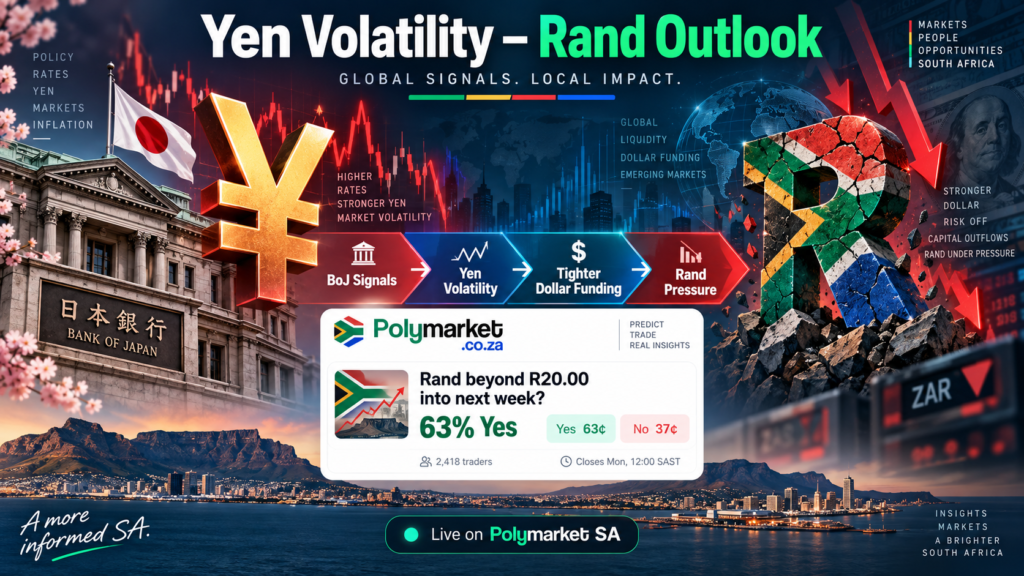
It’s Friday 18 September 2026, and the market’s attention has shifted from this week’s Federal Reserve aftermath to the Bank of Japan. Fresh policy signals and yen volatility matter because Japan remains a major source of global funding. When the yen moves sharply, it can force investors to unwind or reprice carry trades, tighten Dollar liquidity, and hit emerging market currencies.
That is the South African link. A disorderly yen move does not stay in Tokyo. It can strengthen the Dollar, reduce risk appetite, and put fresh pressure on the Rand just as local traders are still digesting a supported Dollar after the Fed. Traders on Polymarket.co.za are watching whether this becomes a one-day FX story or a broader funding shock.
1. Yen Volatility Is a Funding Story, Not Just a Japan Story
The Bank of Japan does not need to deliver a dramatic hike to move markets. Even a shift in language around yields, intervention, or the pace of normalisation can reprice the yen and force global investors to adjust Dollar funding positions.
On Polymarket SA, traders are pricing the near-term currency outlook:
- The probability of the Rand weakening beyond R20.00 to the USD into next week is currently trading at approximately 63% Yes.
- Markets linked to Dollar strength and emerging market funding stress have seen increased Friday interest.
2. The Local Transmission Channel Is Still the Rand and Import Costs
If yen-driven flows push the Dollar higher into the weekend, South Africa feels it through fuel, food imports, and capital goods. That is why local traders are not treating BoJ headlines as distant noise.
Current pricing on Polymarket SA reflects that pass-through risk:
- Markets related to fuel-price pressure and imported inflation remain active.
- Traders are watching whether a firmer Dollar into next week spills into the next local cost-of-living debate.
3. SARB’s Policy Backdrop
The South African Reserve Bank already faces a firm Dollar backdrop after the Fed. Additional FX volatility from Japan would not make an early rate cut easier to justify if the Rand weakens at the same time.
On Polymarket SA, the market currently shows:
- The probability of a SARB rate cut before the end of Q3 2026 is priced at approximately 43% Yes.
- Traders now see global funding conditions, not only US data, as part of the SARB’s external constraint.
4. How Traders Are Positioning Into the Weekend
Traders on Polymarket SA are treating the BoJ-yen move as a weekend risk event. Current popular strategies include:
- Positions that capture the probability of further near-term Rand pressure if Dollar liquidity tightens
- Hedged views that allow for a bounce if the yen move fades
- Selective interest in how imported inflation and fuel costs could keep SARB cut odds in check
5. Domestic Factors Can Still Cut Across the Global FX Story
Even with Japan leading the conversation, South African export receipts, logistics, and local energy developments can still move the Rand. Traders are keeping those domestic inputs in view in case they either amplify or offset the external FX shock.

How Smart South African Traders Are Positioning Right Now
The real edge on Polymarket SA this week comes from seeing the BoJ as a global funding event, not a faraway policy footnote. Successful traders are focusing on:
- Whether yen volatility keeps the Dollar supported
- The impact on Rand-imported fuel and food costs
- The SARB’s likely response if currency weakness persists into next week
How to Start Trading Global Events Through SA Eyes in Under 5 Minutes
- Visit Polymarket.co.za and create an account.
- Complete the quick local ID verification process.
- Deposit funds using EFT or your preferred South African payment method.
- Explore the Economy, South Africa, and Global market categories.
- Select contracts that best reflect your view on the Rand, the Dollar, or SARB policy.
- Buy Yes or No shares and actively manage your positions as new information emerges.

Why South Africans Are Choosing Polymarket.co.za
Polymarket.co.za gives traders direct exposure to how global funding shocks and central bank signals affect South Africa — from currency weakness to imported inflation and monetary policy — with real-time pricing and no traditional bookmaker margins.
Don’t Just Watch Global Events — Trade Their South African Impact
Bank of Japan signals, yen volatility, and the implications for the Dollar and the Rand are creating clear trading opportunities right now.
Sign up today and start trading the global impact on South Africa.
FAQ – Global Events & Prediction Markets South Africa 18 September 2026
Q: Is Polymarket legal and regulated in South Africa?
A: Yes. Polymarket.co.za is fully regulated and built specifically for South African users.
A: Yes. Polymarket.co.za is fully regulated and built specifically for South African users.
Q: Why do Bank of Japan signals matter for the Rand?
A: Yen moves can tighten global Dollar funding and reduce risk appetite, both of which tend to put pressure on emerging market currencies such as the Rand.
A: Yen moves can tighten global Dollar funding and reduce risk appetite, both of which tend to put pressure on emerging market currencies such as the Rand.
Q: Can I trade these markets on my phone?
A: Yes, the platform is fully mobile-optimised.
A: Yes, the platform is fully mobile-optimised.
Q: What makes these markets different from traditional betting?
A: There are no bookmaker margins — winners take the full pool based on the actual outcome.
A: There are no bookmaker margins — winners take the full pool based on the actual outcome.
Official content partner of Polymarket.co.za – South Africa’s #1 Prediction Market