
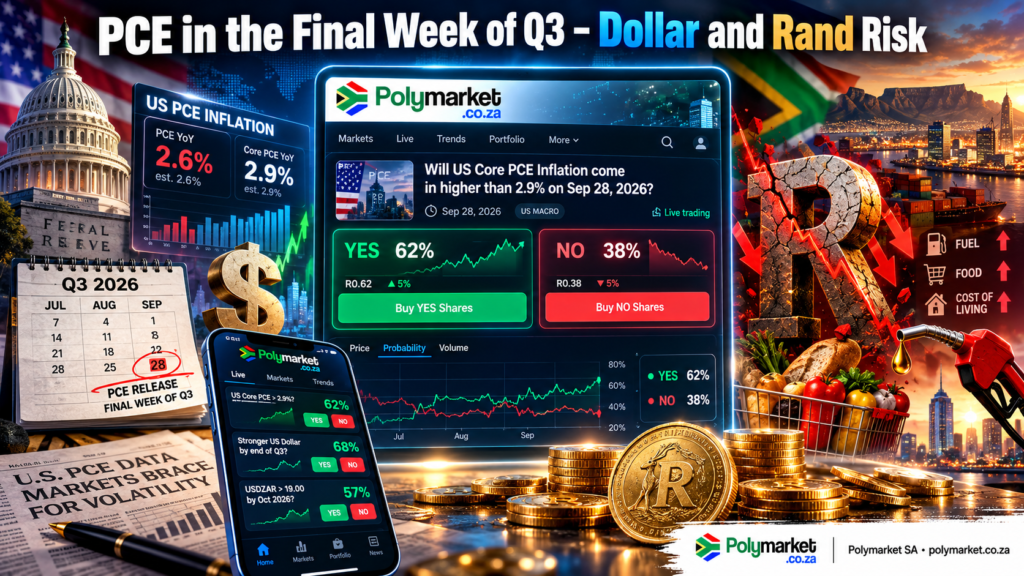
It’s Monday 28 September 2026, and the final week of the third quarter opens with a high-impact US data point: personal consumption expenditures inflation. PCE is the Federal Reserve’s preferred inflation gauge, which means it can move the Dollar just as global funds are still finishing quarter-end positioning.
That combination matters for South Africa. A firm PCE print can keep the Dollar supported, put pressure on the Rand, and raise the rand cost of fuel and other imports heading into October. A cooler print could ease some of that pressure, but it would have to land clearly below expectations to change the late-quarter tone. Traders on Polymarket.co.za are treating this as both a data event and a calendar event.
1. PCE Matters More Than Usual Because the Quarter Is Closing
In a normal week, PCE is already important. In the last sessions of Q3, it can also interact with fund rebalancing. If the data keep inflation sticky, Dollar demand can rise just as some investors are reducing emerging market exposure.
On Polymarket SA, traders are pricing the near-term currency outlook:
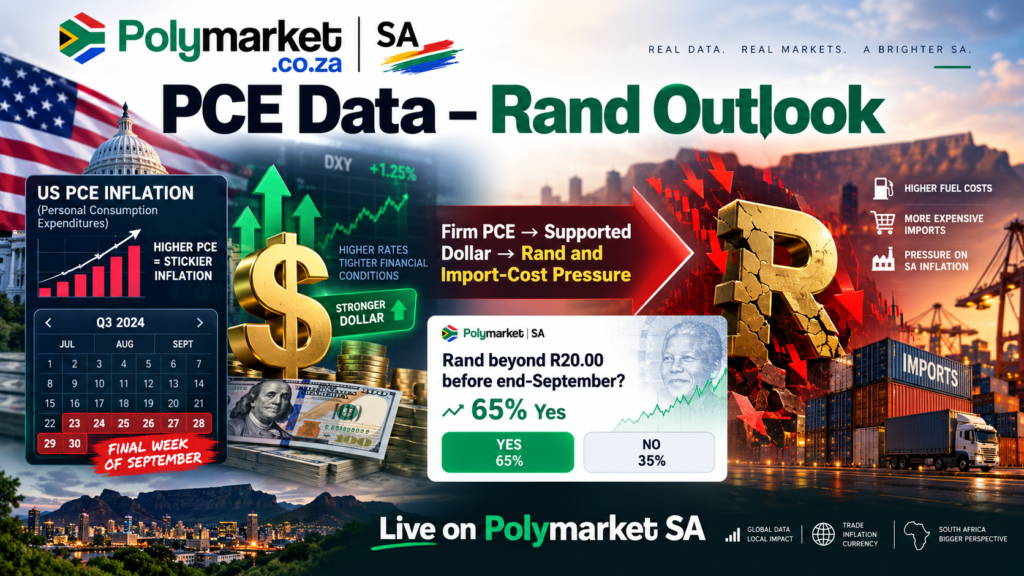
- The probability of the Rand weakening beyond R20.00 to the USD before the end of September is currently trading at approximately 65% Yes.
- Markets linked to sticky US inflation and a firmer Dollar into the quarter close have seen fresh interest.
2. The Local Transmission Channel Is Still Import Costs
If PCE supports the Dollar, South Africa feels it through fuel, food imports, and capital goods. That is why local traders are mapping the US release onto the next fuel adjustment and the broader inflation backdrop, not only onto USDZAR.
Current pricing on Polymarket SA reflects that pass-through risk:
- Markets related to fuel-price pressure and imported inflation remain active.
- Traders are watching whether a firm Dollar into the Q3 close spills into October cost-of-living expectations.
3. SARB’s Policy Backdrop
The South African Reserve Bank is heading toward the end of the quarter with the same core problem: imported inflation risk versus domestic growth. A hot PCE print would not make an early cut easier to justify if the Rand weakens at the same time.
On Polymarket SA, the market currently shows:
- The probability of a SARB rate cut before the end of Q3 2026 is priced at approximately 40% Yes.
- With only a few sessions left in the quarter, traders see the window for a cut as narrow unless both the Rand and the inflation backdrop improve quickly.
4. How Traders Are Positioning Into the PCE Release
Traders on Polymarket SA are treating the final week of Q3 as an event-risk week. Current popular strategies include:
- Positions that capture the probability of further Rand pressure if PCE stays firm
- Hedged views that allow for Rand relief if the inflation data cool more than expected
- Selective interest in how the print could reprice SARB cut odds heading into October
5. Domestic Factors Can Still Cut Across the Data
Even with PCE leading the global conversation, South African export receipts, logistics, and local energy developments can still move the Rand. Traders are keeping those domestic inputs in view in case they either amplify or offset the US data shock.

How Smart South African Traders Are Positioning Right Now
The real edge on Polymarket SA this week comes from connecting a US inflation print to local prices during a quarter-end week. Successful traders are focusing on:
- Whether PCE keeps the Dollar supported into 30 September
- The impact on Rand-imported fuel and food costs
- The SARB’s likely response if currency weakness persists into the Q3 close
How to Start Trading Global Events Through SA Eyes in Under 5 Minutes
- Visit Polymarket.co.za and create an account.
- Complete the quick local ID verification process.
- Deposit funds using EFT or your preferred South African payment method.
- Explore the Economy, South Africa, and Global market categories.
- Select contracts that best reflect your view on the Rand, inflation, or SARB policy.
- Buy Yes or No shares and actively manage your positions as new information emerges.

Why South Africans Are Choosing Polymarket.co.za
Polymarket.co.za gives traders direct exposure to how US inflation data and quarter-end Dollar moves affect South Africa — from currency weakness to imported inflation and central bank policy — with real-time pricing and no traditional bookmaker margins.
Don’t Just Watch Global Events — Trade Their South African Impact
The PCE release, late-quarter Dollar risk, and the implications for the Rand are creating clear trading opportunities right now.
Sign up today and start trading the global impact on South Africa.
FAQ – Global Events & Prediction Markets South Africa 28 September 2026
Q: Is Polymarket legal and regulated in South Africa?
A: Yes. Polymarket.co.za is fully regulated and built specifically for South African users.
A: Yes. Polymarket.co.za is fully regulated and built specifically for South African users.
Q: Why does US PCE data matter for the Rand?
A: PCE is the Fed’s preferred inflation gauge. A firm print can support the Dollar and raise South Africa’s imported fuel and food costs, putting pressure on the Rand.
A: PCE is the Fed’s preferred inflation gauge. A firm print can support the Dollar and raise South Africa’s imported fuel and food costs, putting pressure on the Rand.
Q: Can I trade these markets on my phone?
A: Yes, the platform is fully mobile-optimised.
A: Yes, the platform is fully mobile-optimised.
Q: What makes these markets different from traditional betting?
A: There are no bookmaker margins — winners take the full pool based on the actual outcome.
A: There are no bookmaker margins — winners take the full pool based on the actual outcome.
Official content partner of Polymarket.co.za – South Africa’s #1 Prediction Market