
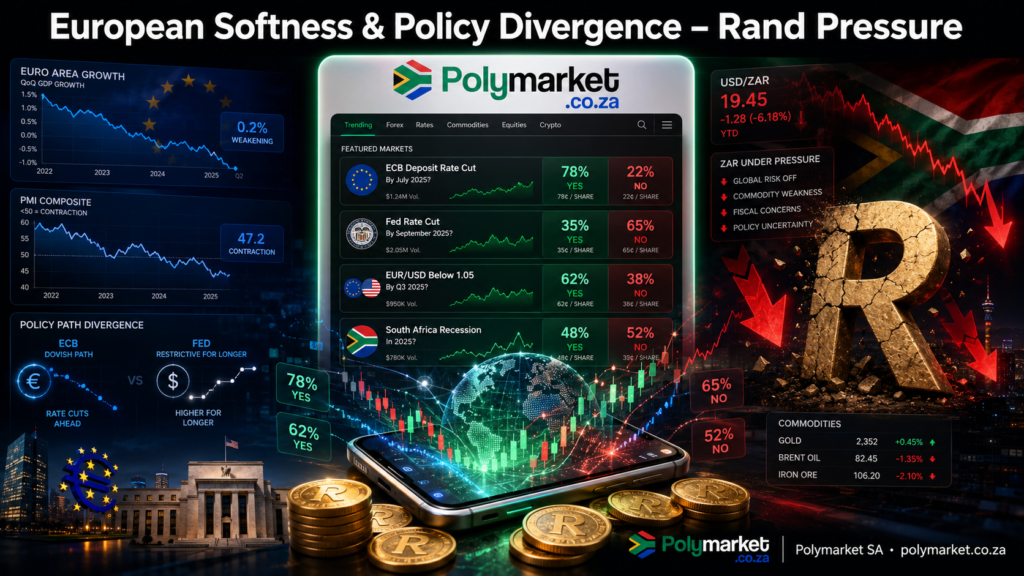
It’s Wednesday 19 August 2026, and recent European economic data has pointed to continued softness in activity across the eurozone. At the same time, markets are closely watching the diverging policy paths of major central banks, particularly the Federal Reserve and the European Central Bank.
Softer European growth can weigh on global risk sentiment and commodity demand, while policy divergence often supports the US Dollar when the Fed is perceived as relatively more hawkish. Both factors tend to create headwinds for emerging market currencies such as the South African Rand.
Traders on Polymarket.co.za are assessing how these European and global monetary developments could influence capital flows, the Rand, and the South African Reserve Bank’s policy outlook in the weeks ahead.
1. European Softness Weighs on Global Risk Appetite
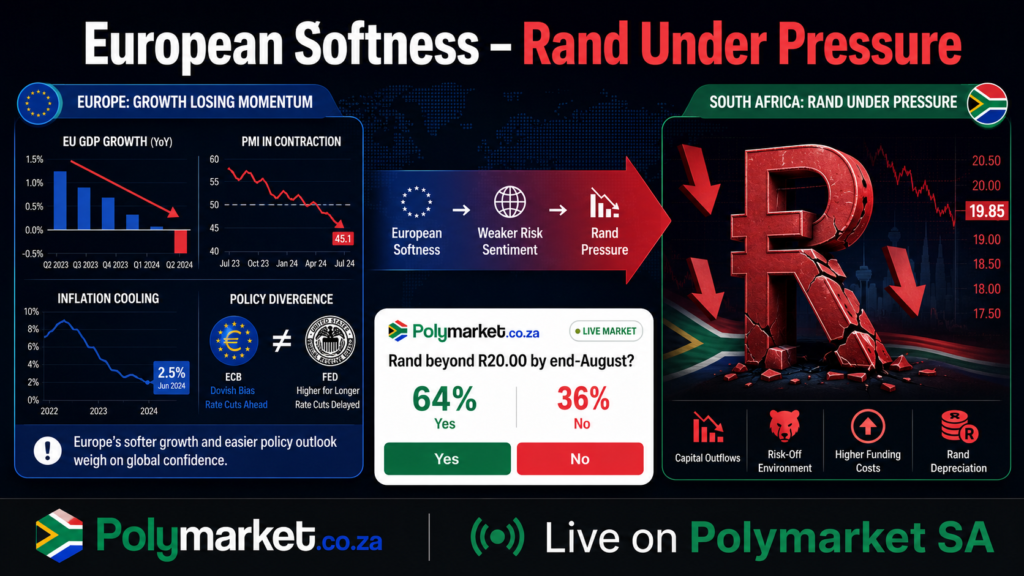
Weaker European economic data typically reduces appetite for higher-risk assets and can dampen demand for industrial commodities. This environment often leads to capital flowing toward safer assets and a firmer US Dollar. On Polymarket SA, traders are pricing the near-term currency outlook:
- The probability of the Rand weakening beyond R20.00 to the USD by end of August is currently trading at approximately 64% Yes.
- Markets linked to risk sentiment and emerging market capital flows have seen steady interest.
2. Policy Divergence and Dollar Support
When major central banks follow different paths — particularly if the Federal Reserve remains more cautious on easing than the ECB — the interest rate differential often supports the US Dollar. A stronger Dollar typically puts pressure on the Rand. Current pricing on Polymarket SA reflects this dynamic:
- Markets related to Dollar strength and yield differentials continue to attract attention.
- Traders are balancing the impact of European softness against broader US data and policy signals.
3. SARB’s Policy Environment
The South African Reserve Bank continues to navigate a complex external environment. A firmer Dollar and softer global growth signals can add to the challenge of managing inflation and supporting domestic activity. On Polymarket SA, the market currently shows:
- The probability of a SARB rate cut before the end of Q3 2026 is priced at approximately 43% Yes.
- Traders expect the SARB to remain data-dependent while monitoring both local inflation trends and external developments.
4. How Traders Are Positioning Around European and Policy Risks
Traders on Polymarket SA are treating the current European softness and policy divergence as meaningful near-term factors. Current popular strategies include:
- Positions that capture the probability of continued near-term Rand pressure
- Hedged views that balance Dollar strength against potential shifts in global risk sentiment
- Selective interest in how European data and central bank signals could influence SARB policy expectations
5. Broader Context for South African Markets
While European data and central bank divergence dominate the near-term narrative, domestic factors such as export performance, logistics efficiency, and overall economic activity continue to shape the medium-term outlook for the Rand. Traders are monitoring both external developments and local fundamentals.

How Smart South African Traders Are Positioning Right Now
The real edge on Polymarket SA comes from correctly assessing how shifts in European growth and global policy divergence interact with local currency and policy dynamics. Successful traders are focusing on:
- The sustainability of European economic softness
- The impact on Dollar strength and capital flows into emerging markets
- The SARB’s likely response to any sustained external pressures
How to Start Trading Global Events Through SA Eyes in Under 5 Minutes
- Visit Polymarket.co.za and create an account.
- Complete the quick local ID verification process.
- Deposit funds using EFT or your preferred South African payment method.
- Explore the Economy, South Africa, and Global market categories.
- Select contracts that best reflect your view on the Rand, capital flows, or SARB policy.
- Buy Yes or No shares and actively manage your positions as new information emerges.

Why South Africans Are Choosing Polymarket.co.za
Polymarket.co.za gives traders direct exposure to how European economic data and global central bank divergence affect South Africa — from currency movements to capital flows and monetary policy — with real-time pricing and no traditional bookmaker margins.
Don’t Just Watch Global Events — Trade Their South African Impact
European economic softness, diverging central bank paths, and the implications for the Rand are creating clear trading opportunities right now.
Sign up today and start trading the global impact on South Africa.
FAQ – Global Events & Prediction Markets South Africa 19 August 2026
Q: Is Polymarket legal and regulated in South Africa?
A: Yes. Polymarket.co.za is fully regulated and built specifically for South African users.
A: Yes. Polymarket.co.za is fully regulated and built specifically for South African users.
Q: How does European economic softness affect the Rand?
A: It can weigh on global risk sentiment and commodity demand while supporting the US Dollar through policy divergence, both of which tend to put pressure on emerging market currencies such as the Rand.
A: It can weigh on global risk sentiment and commodity demand while supporting the US Dollar through policy divergence, both of which tend to put pressure on emerging market currencies such as the Rand.
Q: Can I trade these markets on my phone?
A: Yes, the platform is fully mobile-optimised.
A: Yes, the platform is fully mobile-optimised.
Q: What makes these markets different from traditional betting?
A: There are no bookmaker margins — winners take the full pool based on the actual outcome.
A: There are no bookmaker margins — winners take the full pool based on the actual outcome.
Official content partner of Polymarket.co.za – South Africa’s #1 Prediction Market