
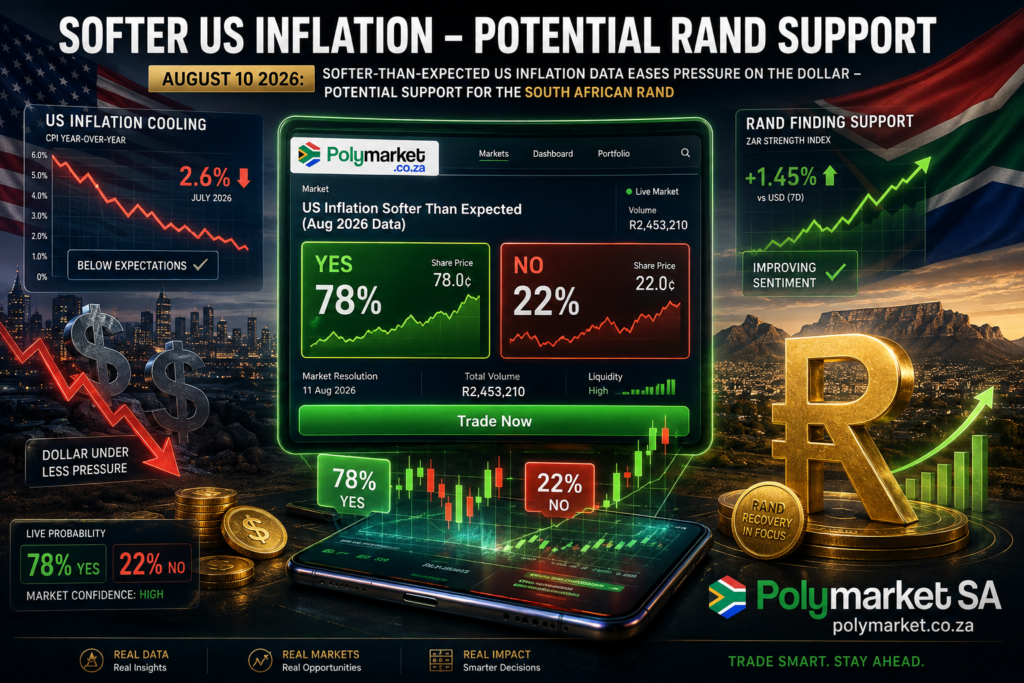
It’s Monday 10 August 2026, and the latest US inflation data has come in softer than market expectations. Both headline and core measures showed more moderation than forecast, raising the possibility that the Federal Reserve may have slightly more room to ease policy later in the year.
The immediate market reaction has been a modest softening of the US Dollar as investors adjust rate expectations. For emerging market currencies such as the South African Rand, a less aggressive Dollar environment can provide some temporary relief from recent pressure.
However, the broader global backdrop — including residual inflation risks, geopolitical uncertainty, and capital flow dynamics — continues to influence the Rand. Traders on Polymarket.co.za are assessing whether the softer US data can deliver meaningful support for the local currency and how it may affect the South African Reserve Bank’s policy path.
1. Softer US Inflation Reduces Some Dollar Support
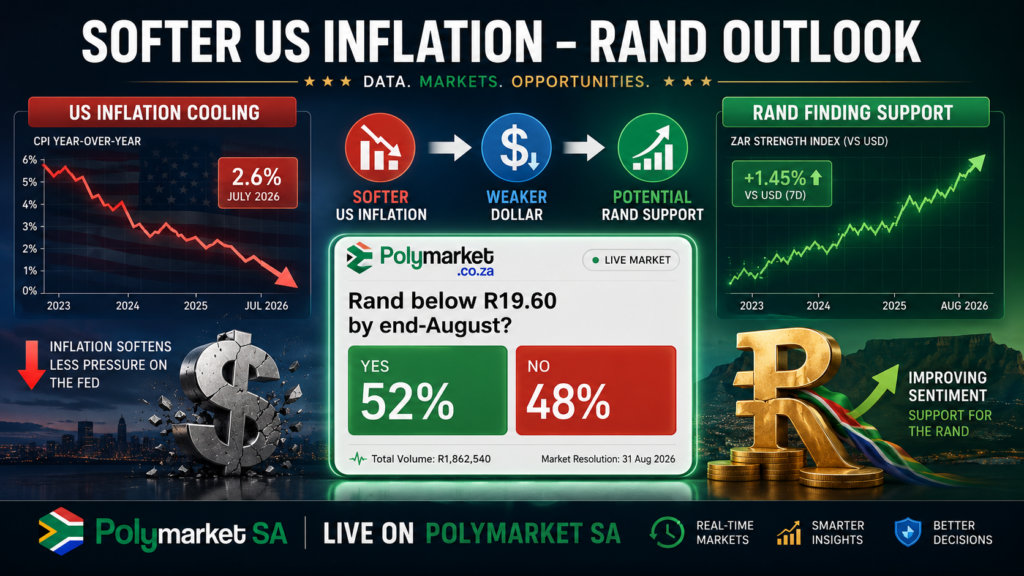
When US inflation comes in below expectations, markets typically price a higher probability of future rate cuts. This can weaken the Dollar and improve risk appetite toward emerging markets. On Polymarket SA, traders are pricing the near-term currency outlook:
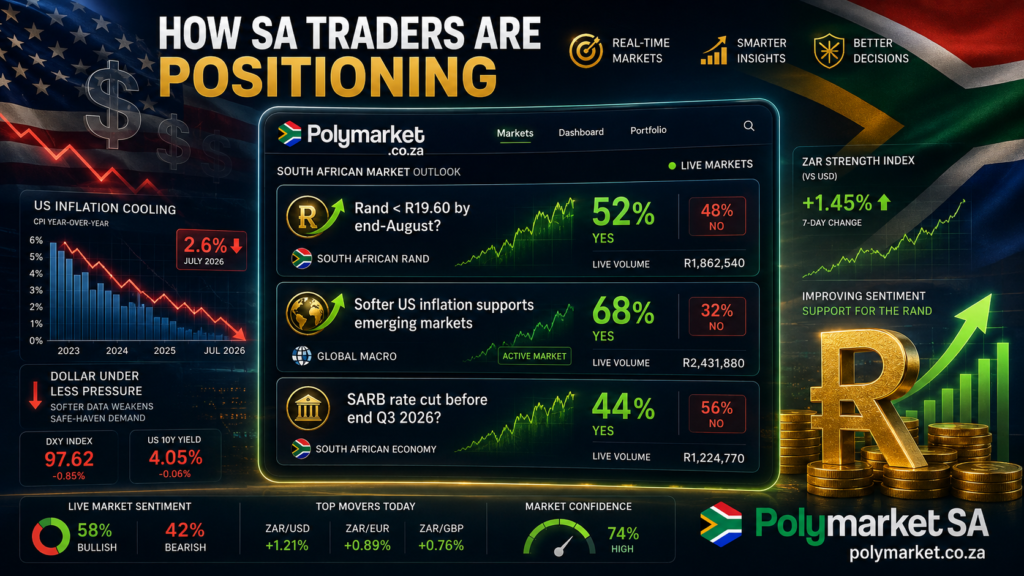
- The probability of the Rand strengthening below R19.60 to the USD by end of August is currently trading at approximately 52% Yes.
- Markets linked to Dollar weakness and improved emerging market sentiment have seen increased interest.
2. Implications for South African Import Costs and Inflation
A softer Dollar, if sustained, would reduce some of the pressure on imported goods and fuel prices in rand terms. This could help ease near-term inflation risks, particularly if global commodity prices remain relatively stable. Current pricing on Polymarket SA reflects this potential relief:
- Markets related to imported inflation pressure and fuel price adjustments have shown a modest improvement in sentiment.
- Traders are monitoring whether the softer US data can translate into a more supportive environment for local inflation.
3. SARB’s Policy Backdrop
The South African Reserve Bank remains focused on anchoring inflation expectations. A less aggressive Dollar environment and any associated reduction in imported inflation pressure could give the SARB slightly more flexibility over time. On Polymarket SA, the market currently shows:
- The probability of a SARB rate cut before the end of Q3 2026 has edged up to approximately 44% Yes.
- Traders expect the SARB to remain data-dependent while assessing both domestic inflation trends and external developments.
4. How Traders Are Positioning After the US Data
Traders on Polymarket SA are treating the softer US inflation print as a constructive but still cautious signal. Current popular strategies include:
- Positions that capture the probability of modest near-term Rand strength
- Hedged views that balance potential Dollar weakness against the risk of renewed global volatility
- Selective interest in how lower US inflation expectations could influence SARB policy pricing
5. Broader Context for South African Markets
While the US inflation data has provided a positive near-term impulse, domestic factors such as export performance, logistics efficiency, and overall economic activity continue to shape the medium-term outlook for the Rand. Traders are monitoring both the external data and local fundamentals.
How Smart South African Traders Are Positioning Right Now
The real edge on Polymarket SA comes from correctly assessing how shifts in US inflation and rate expectations interact with local currency and policy dynamics. Successful traders are focusing on:
- Whether the softer inflation trend can be sustained
- The impact on Dollar strength and capital flows into emerging markets
- The SARB’s likely response to any reduction in external inflation pressure
How to Start Trading Global Events Through SA Eyes in Under 5 Minutes
- Visit Polymarket.co.za and create an account.
- Complete the quick local ID verification process.
- Deposit funds using EFT or your preferred South African payment method.
- Explore the Economy, South Africa, and Global market categories.
- Select contracts that best reflect your view on the Rand, inflation, or SARB policy.
- Buy Yes or No shares and actively manage your positions as new information emerges.
Why South Africans Are Choosing Polymarket.co.za
Polymarket.co.za gives traders direct exposure to how US inflation data and global rate expectations affect South Africa — from currency movements to capital flows and central bank policy — with real-time pricing and no traditional bookmaker margins.
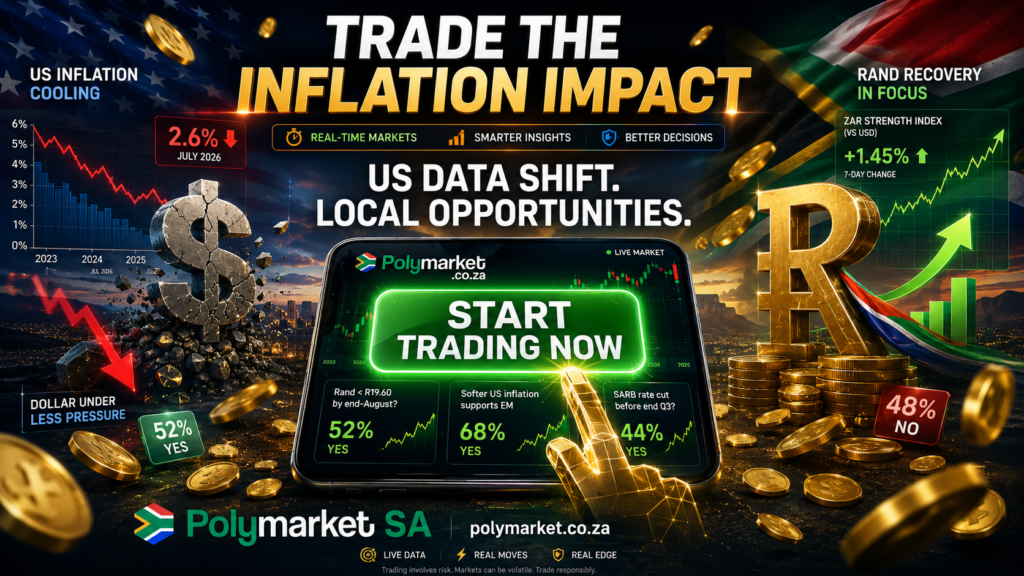
Don’t Just Watch Global Events — Trade Their South African Impact
Softer US inflation data, a potentially softer Dollar, and the implications for the Rand are creating clear trading opportunities right now.
Sign up today and start trading the global impact on South Africa.
Follow SAPolyMarket for daily hot market alerts real-world trending events.
FAQ – Global Events & Prediction Markets South Africa 10 August 2026
Q: Is Polymarket legal and regulated in South Africa?
A: Yes. Polymarket.co.za is fully regulated and built specifically for South African users.
A: Yes. Polymarket.co.za is fully regulated and built specifically for South African users.
Q: How does softer US inflation affect the Rand?
A: It can reduce pressure on the US Dollar and improve risk appetite toward emerging markets, which may provide temporary support for the Rand.
A: It can reduce pressure on the US Dollar and improve risk appetite toward emerging markets, which may provide temporary support for the Rand.
Q: Can I trade these markets on my phone?
A: Yes, the platform is fully mobile-optimised.
A: Yes, the platform is fully mobile-optimised.
Q: What makes these markets different from traditional betting?
A: There are no bookmaker margins — winners take the full pool based on the actual outcome.
A: There are no bookmaker margins — winners take the full pool based on the actual outcome.
Official content partner of Polymarket.co.za – South Africa’s #1 Prediction Market