
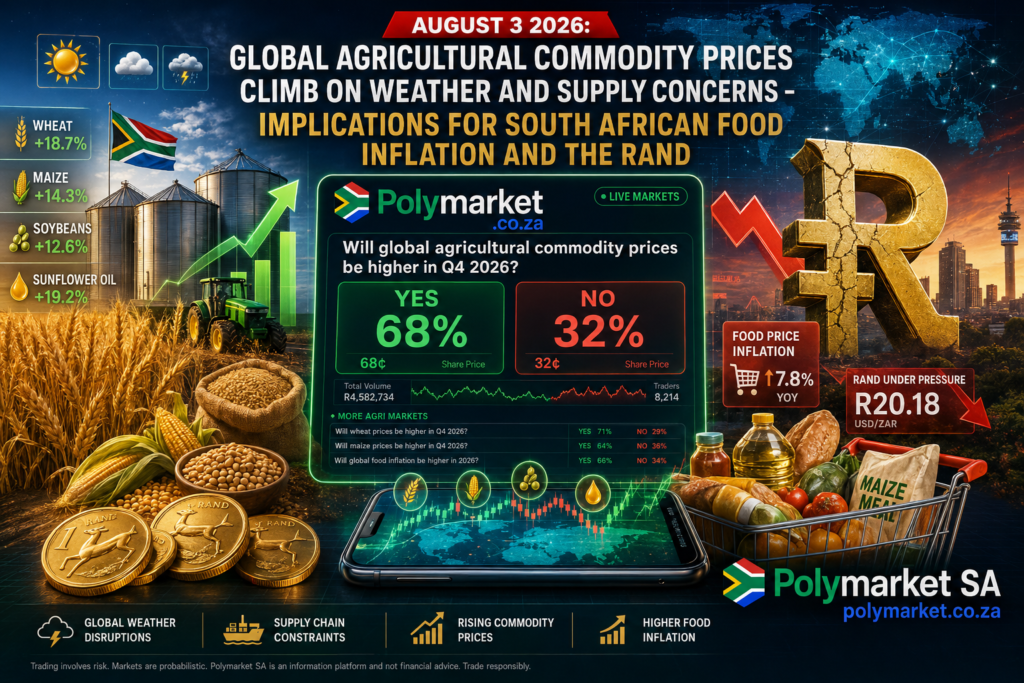
It’s Monday 3 August 2026, and global agricultural commodity prices have moved higher in recent sessions. Weather-related supply concerns in key producing regions, combined with ongoing logistical challenges, have supported prices for grains, oilseeds and other staple crops.
For South Africa — a country that both produces and imports significant volumes of agricultural commodities — these price movements carry direct implications. Higher global food prices can feed into local food inflation, raise the cost of imported staples, and influence the broader inflation trajectory. At the same time, the Rand remains sensitive to shifts in global risk sentiment and the strength of the US Dollar.
Traders on Polymarket.co.za are assessing how these global agricultural developments translate into South African outcomes — particularly food inflation, import costs, the Rand, and the South African Reserve Bank’s policy path.
1. Rising Global Agricultural Prices Feed into Local Food Costs
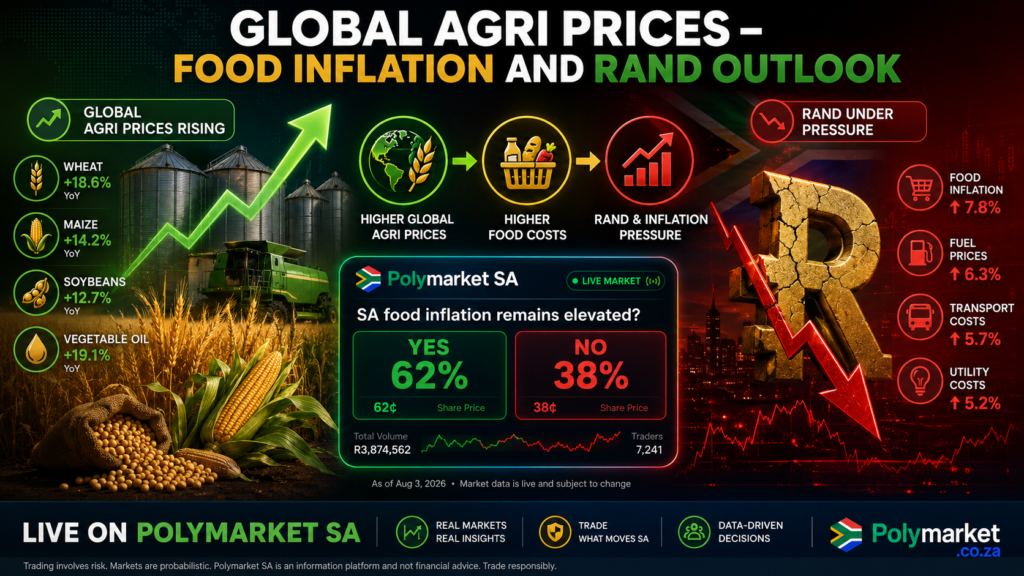
Higher prices for wheat, maize, and other key agricultural commodities increase the cost of imported food products and can also influence local pricing dynamics. This is particularly relevant for South African consumers, where food inflation remains a sensitive component of the overall consumer price index.
On Polymarket SA, traders are pricing the near-term impact:
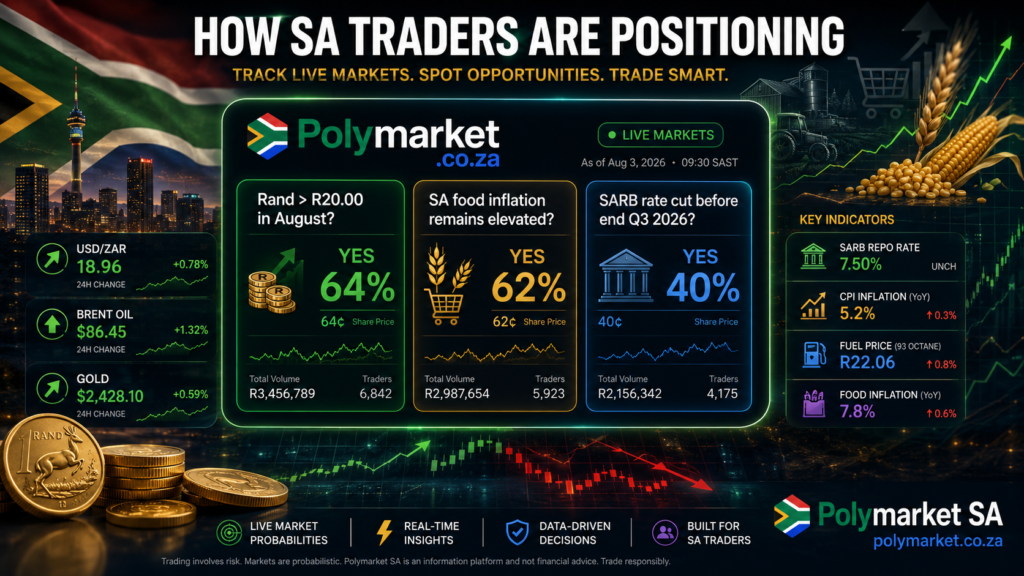
- The probability that South African food inflation remains elevated in the coming months is currently trading at approximately 62% Yes.
- Markets linked to imported food cost pressures have seen steady interest.
2. Implications for the Rand and Import Costs
A combination of higher global agricultural prices and any associated risk-off sentiment can weigh on emerging market currencies. A weaker Rand amplifies the local impact by making imported food more expensive in rand terms.
Current pricing on Polymarket SA reflects this dynamic:
- The probability of the Rand weakening beyond R20.00 to the USD in August is currently trading at around 64% Yes.
- Traders are balancing the direct effect of higher agricultural prices against broader currency and risk factors.
3. SARB’s Policy Challenge
Elevated food inflation adds to the complexity of the South African Reserve Bank’s policy decisions. Persistent pressure on food prices can keep overall inflation higher for longer and reduce the room for rate cuts. On Polymarket SA, the market currently shows:
- The probability of a SARB rate cut before the end of Q3 2026 is priced at approximately 40% Yes.
- Traders expect the SARB to remain cautious while monitoring both global commodity developments and local inflation data.
4. How Traders Are Positioning Around Food and Currency Risks
Traders on Polymarket SA are treating the current agricultural price environment as a multi-layered risk. Current popular strategies include:
- Positions that capture the probability of sustained food inflation pressure
- Hedged views on Rand performance that balance higher import costs against other commodity and risk factors
- Selective interest in how food price developments could influence SARB policy expectations
5. Domestic Agricultural and Logistical Context
While global prices are an important driver, South Africa’s domestic agricultural production, storage capacity, and logistics performance also influence the final impact on local food prices. Traders continue to monitor these domestic variables as they can either amplify or mitigate global price shocks.
How Smart South African Traders Are Positioning Right Now
The real edge on Polymarket SA comes from correctly assessing how global agricultural price movements interact with local inflation and currency dynamics. Successful traders are focusing on:
- The sustainability of the current agricultural price rally
- The pass-through into South African food inflation
- The SARB’s likely response to any sustained pressure on the inflation outlook
How to Start Trading Global Events Through SA Eyes in Under 5 Minutes
- Visit Polymarket.co.za and create an account.
- Complete the quick local ID verification process.
- Deposit funds using EFT or your preferred South African payment method.
- Explore the Economy, South Africa, and Global market categories.
- Select contracts that best reflect your view on the Rand, food inflation, or SARB policy.
- Buy Yes or No shares and actively manage your positions as new information emerges.
Why South Africans Are Choosing Polymarket.co.za
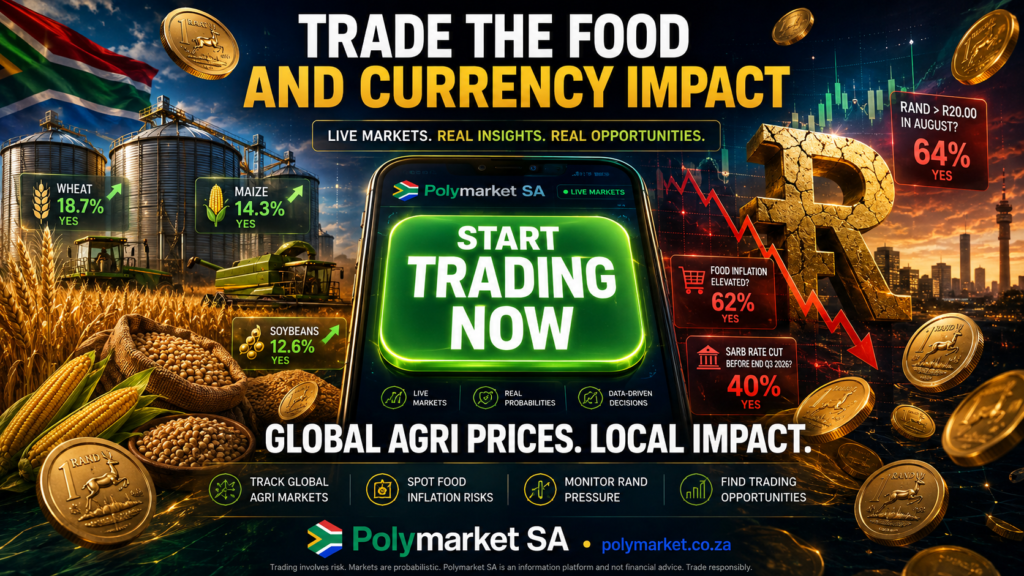
Polymarket.co.za gives traders direct exposure to how global commodity developments — such as agricultural price movements — affect South Africa, from food inflation to the Rand and central bank policy, with real-time pricing and no traditional bookmaker margins.
Don’t Just Watch Global Events — Trade Their South African Impact
Rising global agricultural prices, pressure on food inflation, and the implications for the Rand are creating clear trading opportunities right now.
Sign up today and start trading the global impact on South Africa.
FAQ – Global Events & Prediction Markets South Africa 3 August 2026
Q: Is Polymarket legal and regulated in South Africa?
A: Yes. Polymarket.co.za is fully regulated and built specifically for South African users.
A: Yes. Polymarket.co.za is fully regulated and built specifically for South African users.
Q: How do higher global agricultural prices affect South Africa?
A: They can increase the cost of imported food, add to local food inflation, and — when combined with a weaker Rand — raise overall import costs.
A: They can increase the cost of imported food, add to local food inflation, and — when combined with a weaker Rand — raise overall import costs.
Q: Can I trade these markets on my phone?
A: Yes, the platform is fully mobile-optimised.
A: Yes, the platform is fully mobile-optimised.
Q: What makes these markets different from traditional betting?
A: There are no bookmaker margins — winners take the full pool based on the actual outcome.
A: There are no bookmaker margins — winners take the full pool based on the actual outcome.
Official content partner of Polymarket.co.za – South Africa’s #1 Prediction Market